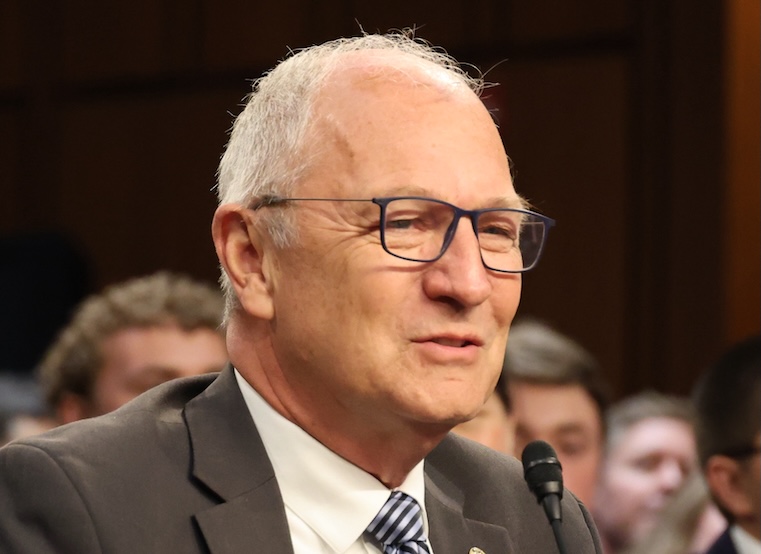
North Dakota – “People who are in the United States illegally and have removal orders shouldn’t be released simply because their home country refuses to take them back,” Sen. Kevin Cramer said, arguing that current immigration law allows some people who have been ordered removed to eventually be released from detention when deportation cannot be completed.
Cramer, a Republican from North Dakota, said a proposed bill would close what he described as a loophole and allow immigration officials to keep certain individuals in custody until they can be deported.
“Unfortunately, that’s exactly what existing law allows,” Cramer said. “Our bill closes this loophole and lets immigration officials keep these individuals in custody until they can be deported.”
His comments came after Sen. Katie Britt, R-Ala., introduced the Keep Our Communities Safe Act with Republican colleagues. Cramer is among the senators supporting the legislation, which seeks to change federal rules governing the detention of people who have received final removal orders but cannot immediately be deported because their home countries will not accept them, FOX News reported.
The legislation targets a legal issue that has shaped immigration detention policy for more than two decades.
Under current law, immigration authorities generally cannot hold someone indefinitely when there is no reasonable prospect that the person will be deported in the foreseeable future. That principle stems in large part from the Supreme Court’s 2001 decision in Zadvydas v. Davis, which addressed the constitutional limits on prolonged detention when removal cannot be completed.
The proposed legislation would give immigration officials additional authority to continue detaining certain individuals in circumstances where deportation efforts remain unresolved.
Supporters argue that the existing system can result in people with final removal orders being released because their countries of origin refuse to accept them. They say that creates a gap between the issuance of a removal order and the government’s ability to actually carry it out.
Britt’s office described the proposal as an effort to close that gap and prevent certain individuals from being released solely because a foreign government will not accept them.
The bill is a new version of legislation that Republican lawmakers have introduced in previous Congresses. Cramer has previously supported similar efforts to expand immigration detention authority.
Earlier versions of the Keep Our Communities Safe Act sought to provide extensions of detention beyond the period generally associated with immigration removal proceedings under certain circumstances. Those circumstances included situations in which removal was expected in the reasonably foreseeable future, an individual failed to cooperate with efforts to secure their removal or continued detention was justified by concerns involving public safety, national security or foreign policy.
The latest proposal comes as Republicans in Congress continue pushing for stricter immigration enforcement and expanded detention authority.
Cramer has made immigration enforcement a recurring focus during his time in the Senate. He previously supported the Laken Riley Act, which expanded mandatory detention requirements for certain undocumented immigrants charged with or convicted of specified crimes.
The senator’s latest comments focused specifically on individuals who already have final removal orders. Cramer argued that the government should have the ability to keep those individuals detained when deportation cannot immediately take place because their destination country refuses to accept them.
The proposal does not simply remove all limits on immigration detention. Instead, its supporters say it establishes additional circumstances under which detention could continue while federal authorities work to complete removal proceedings.
Republican lawmakers supporting the bill have framed the measure as a way to prevent what they describe as a cycle in which individuals receive removal orders but are eventually released because deportation cannot be carried out.
The legislation will have to move through the congressional process before becoming law, including consideration by the Senate. Its future will depend on whether it receives enough support to advance through Congress.
For Cramer and the bill’s other supporters, the central argument is that a final removal order should have practical consequences even when a foreign government refuses or is unable to accept the person being deported. They argue that changing the detention rules would give immigration officials more authority to keep certain individuals in custody while efforts to complete their removal continue.