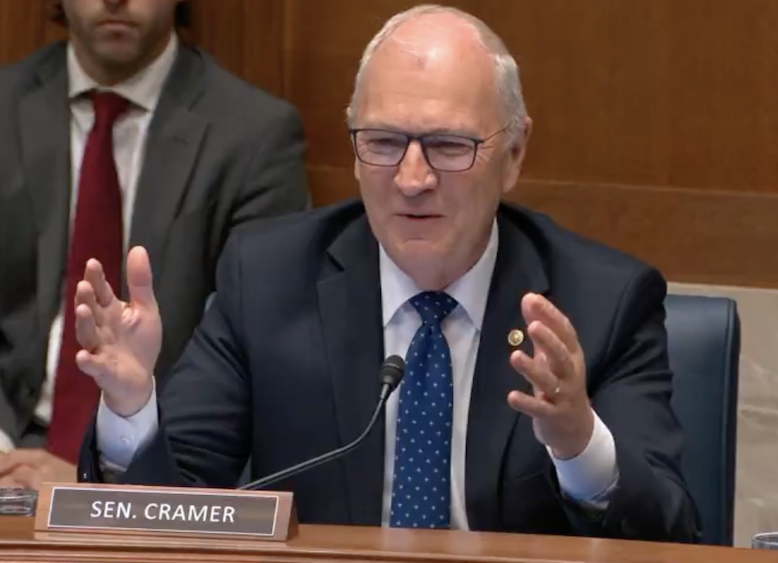
North Dakota – “Democrats have made it clear their distaste of President Trump is greater than their willingness to do their job and pass a full appropriations bill for the year,” Sen. Kevin Cramer said after the Senate approved a short-term funding measure aimed at preventing another federal government shutdown.
Cramer, a Republican from North Dakota, supported the continuing resolution, or CR, which passed the Senate by a 90-6 vote. The measure would fund the federal government through Dec. 11, giving lawmakers additional time to complete full-year appropriations legislation. It now moves to the House of Representatives for consideration.
“While a continuing resolution is not ideal, it removes the threat of a shutdown and gives us more time to get a full-year appropriations bill done,” Cramer said. “The House should pass this quickly and get it to the President’s desk.”
The Senate’s action came as lawmakers work to avoid another government funding crisis ahead of the Sept. 30 end of the fiscal year. Rather than completing all of the regular appropriations bills before that deadline, Congress is considering temporary funding to keep federal agencies operating while negotiations continue.
The Senate measure would generally maintain existing funding while making adjustments for several priorities. According to Cramer’s office, the CR includes funding extensions for highway, rail and transit programs and provides additional support for programs including the Special Supplemental Nutrition Program for Women, Infants, and Children, commonly known as WIC.
The legislation also includes funding for national security priorities, including shipbuilding, as well as additional resources for the federal Disaster Relief Fund.
The measure differs from a House-passed funding proposal, creating another step before a final agreement can reach President Donald Trump. Reuters reported that the Senate and House versions contain differences that lawmakers will need to resolve before a bill can be sent to the president.
The Senate’s 90-6 vote represented broad bipartisan support for the temporary funding measure. The Associated Press reported that the legislation passed with an overwhelming majority as senators sought to prevent a shutdown and avoid another disruption to federal operations.
The timing is significant because the proposed extension would carry federal funding beyond the November midterm elections and into December. The Senate version would keep the government funded through Dec. 11, while the House has considered a version with a different expiration date.
Cramer acknowledged that a continuing resolution is not his preferred approach, emphasizing that Congress should ultimately approve full-year appropriations rather than repeatedly relying on temporary funding measures.
However, he argued that passing the CR would remove the immediate threat of a shutdown and provide lawmakers additional time to complete the broader appropriations process.
The senator also pointed to the consequences of previous government shutdowns as an argument for avoiding another funding lapse. In his statement, Cramer cited disruptions involving air travel, federal employees and military personnel during a recent 76-day shutdown of the Department of Homeland Security.
According to the figures cited by Cramer, that shutdown contributed to the cancellation of 7,500 flights, cost the travel industry $2.6 billion and resulted in more than 1,000 Transportation Security Administration officers leaving the workforce. He also said about 1.3 million service members faced uncertainty over their pay.
The current proposal is therefore intended to provide a temporary bridge while Congress works on the larger spending bills for the fiscal year.
The Senate’s action does not by itself prevent a shutdown. The House must still consider the Senate-approved legislation, and lawmakers from both chambers must resolve differences between their respective proposals before the measure can become law.
For Cramer, the immediate priority is preventing a disruption while keeping pressure on Congress to finish the full appropriations process.
“While a continuing resolution is not ideal,” Cramer said, “it removes the threat of a shutdown and gives us more time to get a full-year appropriations bill done.”