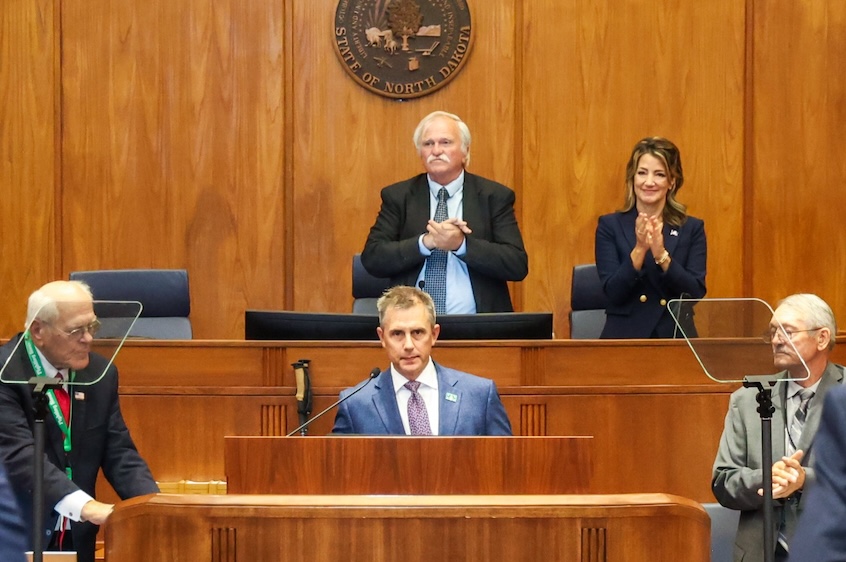
North Dakota – Gov. Kelly Armstrong called on North Dakota lawmakers to permanently ban kratom during his State of the State Address on Sept. 2, warning that the unregulated substance had become a public safety and public health concern.
“We are here to address a public safety and a public health issue that simply cannot wait for the regular legislative calendar to run its course,” Armstrong said. “People were overdosing and dying from a product they could buy off the shelf without any regulations or age restrictions.”
Armstrong made the remarks as lawmakers gathered for a special session of the 69th Legislative Assembly focused largely on kratom. The governor had already temporarily banned the sale, use and possession of all kratom and kratom products in North Dakota through an executive order issued Aug. 3.
During his address, Armstrong asked lawmakers to go beyond regulating certain synthetic kratom products and prohibit kratom in all forms.
He also asked legislators to codify an emergency rule issued by the North Dakota Board of Pharmacy, clarify enforcement authority and establish criminal penalties for the purchase and sale of synthetic kratom.
The governor pointed to concerns surrounding concentrated and synthetic kratom-related compounds, including 7-hydroxymitragynine, or 7-OH. The state’s emergency rule classified several kratom-related, opioid-like compounds as Schedule I controlled substances.
Armstrong said that, at minimum, kratom purchases should be restricted to people 21 and older and products should be subject to truth-in-labeling requirements. However, he questioned whether labeling requirements alone would be effective without broader federal regulation.
The push for a permanent ban came as lawmakers considered several approaches to kratom. Legislative proposals included regulating natural kratom products while banning synthetic derivatives such as 7-OH, while other lawmakers supported a complete ban.
The permanent ban gained momentum during the special session. Senate Bill 2408 was amended to include natural kratom and passed the Senate by a 46-1 vote. The measure would have permanently prohibited kratom in all forms.
However, on Friday, Sept. 4, the North Dakota House rejected Senate Bill 2408, the measure that would have permanently banned kratom in all its forms. The bill failed by one vote, with 46 representatives voting in favor and 47 against it. It needed 48 votes to pass.
The House rejection dealt a setback to Armstrong’s call for a complete ban. However, lawmakers ultimately approved a different approach through House Bill 1628, which bans synthetic kratom products while allowing natural kratom under strict state regulations.
House Bill 1628 prohibits the sale, possession and use of synthetic kratom products, including synthetic derivatives such as 7-OH and other compounds. It also restricts the sale of natural kratom to people 21 and older and requires truth-in-labeling, including information about ingredients and the amounts of mitragynine and 7-OH.
The law also requires kratom retailers to obtain an annual license and prohibits products from being packaged to imitate candy or marketed in a way that appeals to a child. Selling kratom without a license is punishable by a Class B misdemeanor.
Armstrong signed House Bill 1628 on Friday after the Legislature gave the measure final passage, calling it a victory for public health and safety while acknowledging that his administration had preferred a total ban.
The governor’s office said the sale of all kratom and kratom products remains prohibited in North Dakota until administrative rules are implemented under the new law. The governor’s office also said Armstrong will rescind his Aug. 3 executive order following the signing of House Bill 1628, as the new law establishes the state’s permanent framework for regulating kratom and kratom products.
Armstrong had cited 23 deaths reported in North Dakota since 2019 in which mitragynine, 7-OH and/or mitragynine pseudoindoxyl were listed as part of the primary cause of death. He also said he empathized with people struggling with kratom addiction and pointed to behavioral health and addiction recovery resources available through the state.
The final legislation means Armstrong did not get the permanent total ban he requested, but North Dakota now has a new permanent framework that bans synthetic kratom products and places restrictions on natural kratom.