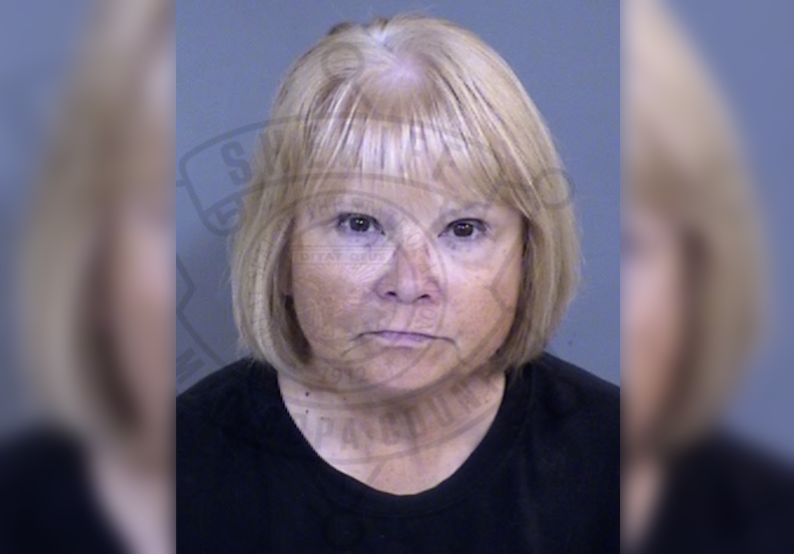
North Dakota – A 65-year-old woman, N. Trotier, was arrested earlier this week and charged with murder in connection with the death of her newborn child more than four decades ago in North Dakota, according to court documents and multiple reports. The case, long known as “Baby Rebeca,” had remained unsolved since 1981 until recent advances in DNA technology led investigators to identify the now-elderly woman as the suspect. Despite that incident, the case continued to move forward, leading to her arrest in Arizona, where she had been living. After the 1981 incident, investigators said the defendant went on to live what appeared to be a normal life. She had no prior criminal record at the time of her arrest. For more than four decades, she worked as a teacher, including 41 years at the North Dakota School for the Deaf, where she taught children with disabilities.
Authorities said the newborn girl was discovered in April 1981 in a wooded area on the campus of VaIIey City State University in VaIIey City. The baby’s body was found with plastic covering her face, and the umbilical cord was still attached, indicating she had been born shortly before her death. The case remained a mystery for decades, deeply affecting the local community and law enforcement officials who continued to seek answers.
According to investigators, the breakthrough came through modern forensic techniques, including DNA testing that was not available at the time of the baby’s death. Evidence collected from the scene decades ago was preserved and later reexamined. Prosecutors said DNA linked to the defendant was identified on items recovered near where the baby was found, including a fingernail clipper and other objects that contained human blood. These findings ultimately led authorities to pursue her as a suspect.
During the investigation, she was interviewed by law enforcement. According to court records, she told investigators, “Maybe it was me,” when confronted with questions about the case. Prosecutors later stated that the DNA evidence played a critical role in confirming her identity as the person connected to the crime scene.
At the time of the baby’s death, she was a college student attending VaIIey City State University and was reportedly in a relationship with the man who would later become her husband. Investigators believe she gave birth and, shortly afterward, suffocated the newborn. Details presented in court indicate that the act occurred shortly after delivery, though authorities have not released extensive additional information about the exact timeline.
Officials also revealed that when the defendant was scheduled to meet again with law enforcement to review DNA findings, she attempted suicide. This information was disclosed during her initial court appearance by the County State’s Attorney Tonia Dufy. Despite that incident, the case continued to move forward, leading to her arrest in Arizona, where she had been living.
After the 1981 incident, investigators said the defendant went on to live what appeared to be a normal life. She had no prior criminal record at the time of her arrest. For more than four decades, she worked as a teacher, including 41 years at the North Dakota School for the Deaf, where she taught children with disabilities. She also raised four children and, according to reports, remained active in her professional and personal life until her retirement in 2024. Following retirement, she moved with her husband to Arizona.
The case has drawn significant attention because of the contrast between the alleged crime and the defendant’s later life. Residents in VaIIey City have said the case lingered in the community for years, with many wondering what happened to the newborn found in 1981. The identification of a suspect after such a long period has brought a measure of resolution, though the circumstances remain difficult for many to process.
She is currently in custody and awaiting further court proceedings, with a hearing expected in May. The charge of murder reflects the seriousness of the allegations and the outcome of the renewed investigation. Arizona authorities have emphasized that the case demonstrates the importance of preserving evidence and the role of advancing technology in solving long-standing crimes.
As the legal process continues, prosecutors are expected to rely heavily on the DNA evidence and Trottier’s statements to investigators. The case now moves forward in court, where the facts will be examined in detail as part of the judicial process.